Learning Outcomes in Listing:
i. Describe anaerobic respiration and its chemical equations.
ii. Understand the contexts in which anaerobic respiration occurs.
iii. Recognize the importance of anaerobic respiration in organisms.
Summary of Lesson:
Anaerobic respiration is a critical biological process that enables energy production in the absence of oxygen. This lesson will delve into the mechanisms and significance of anaerobic respiration, providing students with a clear understanding of its role in both prokaryotic and eukaryotic organisms.
i. Anaerobic Respiration Defined:
Anaerobic respiration is a type of respiration that occurs when oxygen is scarce or absent, resulting in the breakdown of glucose to release energy.
Word and Symbol Equations:
- In muscle cells: Glucose is converted into lactic acid and energy. The word equation is:
- Glucose → Lactic acid + Energy
- The symbol equation is:
- In yeast (fermentation): Glucose is converted into ethanol and carbon dioxide. The word equation is:
- Glucose → Ethanol + Carbon dioxide + Energy
- The symbol equation is:
ii. Importance of Anaerobic Respiration:
- Anaerobic respiration allows organisms to produce energy without oxygen, which is vital for survival in anaerobic environments.
- It plays a role in industries such as brewing and baking, where yeast ferments sugars to produce alcohol and carbon dioxide.
- During intense exercise, human muscles perform anaerobic respiration, providing energy when oxygen levels are insufficient for aerobic respiration.
List of Important Questions for Self-Study:
i. What conditions lead to anaerobic respiration in cells?
ii. How does the production of lactic acid in muscles relate to exercise?
iii. What are some practical applications of anaerobic respiration in industry?
iv. How do the products of anaerobic respiration differ from those of aerobic respiration?
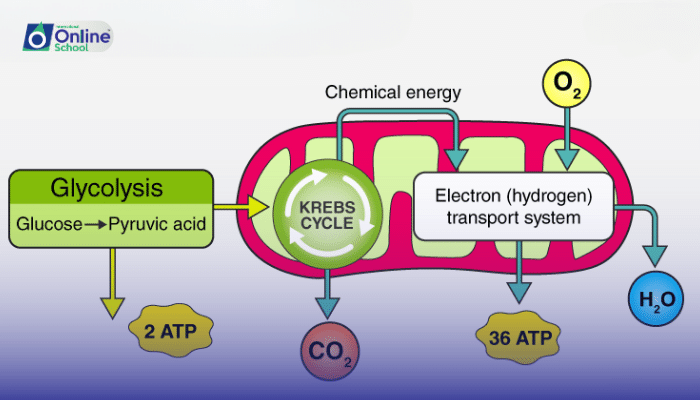
v. Why is anaerobic respiration less efficient than aerobic respiration in terms of energy production?
Important Terminologies Used in Lesson:
i. Anaerobic Respiration: Respiration that does not require oxygen and results in the partial breakdown of glucose to release energy.
ii. Lactic Acid: An organic acid produced in muscles during rapid exercise when the body cannot supply enough oxygen to the tissues.
iii. Ethanol: A type of alcohol produced by the fermentation of sugars by yeast.
iv. Fermentation: The chemical breakdown of a substance by bacteria, yeasts, or other microorganisms, typically involving effervescence and the giving off of heat.
